
Written by
Ines Marlowe
Filed under
Essays
From
Issue 14
I started writing by hand again by accident. A laptop died on a train between Porto and Lisbon, and for three hours the only instrument I had was a cheap notebook and a pen borrowed from the woman across the aisle.
By the time we reached Santa Apolónia I had written eleven pages, crossed out four of them, and understood something about my own work that a year of typing had hidden from me: I had been writing too fast to notice what I actually thought.
The friction is the feature
Every tool shapes the thoughts it carries. A keyboard rewards speed and makes deletion free, so we produce more and keep less. A pen makes each word cost something — a little ink, a little time, a little commitment — and that cost turns out to be a kind of editing that happens before the sentence exists.
Writing by hand is slow enough that the mind arrives at the page at the same time as the words.
Researchers have spent two decades measuring what the hand does for memory. The findings are modest but consistent: people who take notes by hand remember concepts better, largely because they cannot transcribe everything and are forced to choose.
Three small rules I now keep
First drafts of anything that matters begin on paper.
The notebook stays offline: no photos, no scans, no backups.
If a paragraph survives being copied out twice, it is probably worth typing.
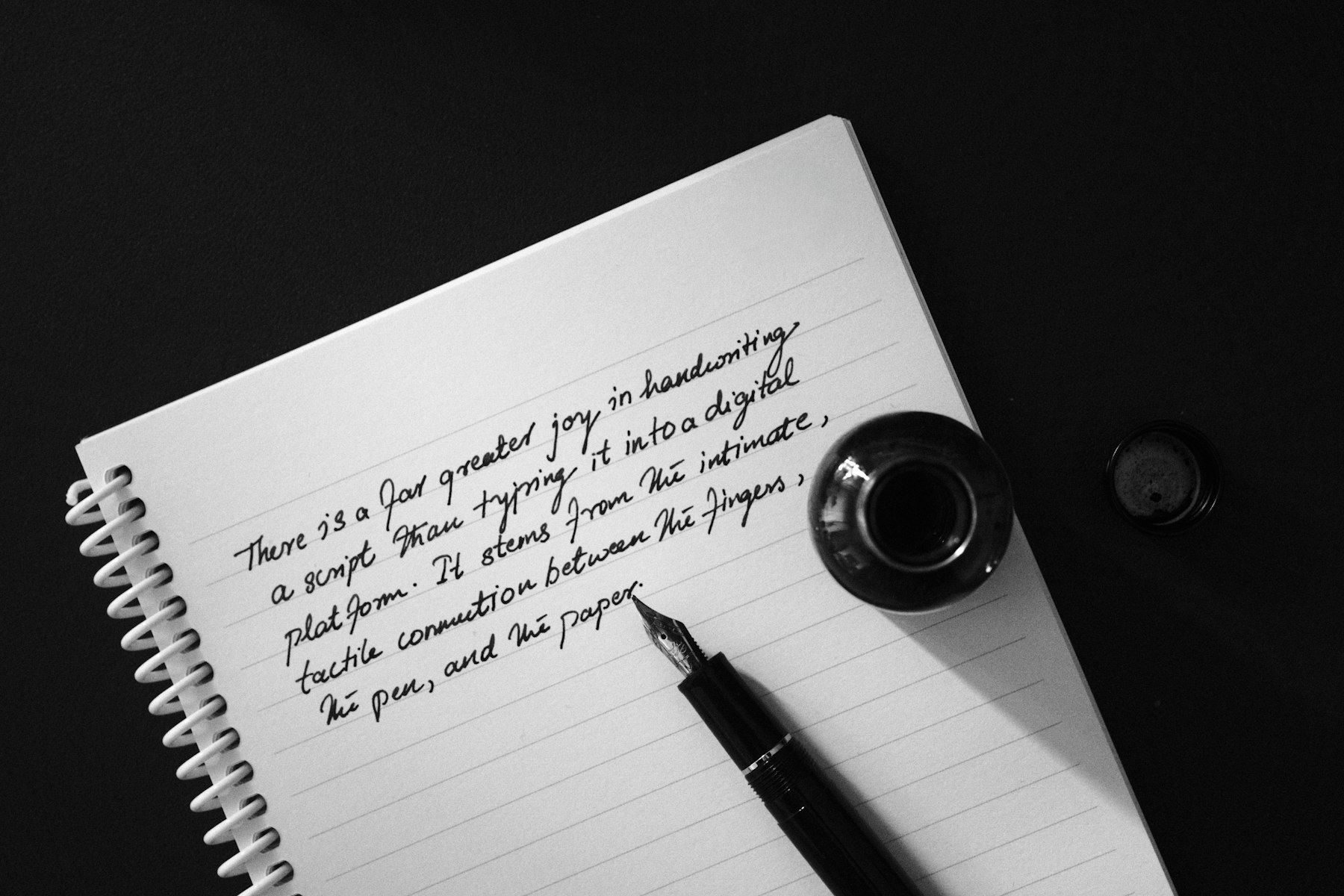
None of this is nostalgia. I still type every finished piece, and I am grateful for the machine that does it. But the thinking happens earlier, at the speed of a hand moving across paper — which is to say, at the speed of a person.

About the author
Ines Marlowe
Ines founded Verenis in 2019 after a decade editing books in Lisbon and London. She writes about attention, handwriting and the economics of slowness.


